
Somebody asked me the other day what it costs to run an AI agent for their business, and I could tell they'd already been out reading the internet, because they said it like they were bracing for a five-figure invoice. And here's the honest answer I gave them: it depends, and the sticker price is usually the smallest part of the whole thing.
I want to walk through the real math on this the way I'd talk through a deal, because there's a lot of noise out there. Some folks will tell you it's basically free. Some will quote you a build that costs as much as a truck. Both of those can be true, and neither one helps you decide. So let me lay out where the money actually goes, in plain dollars, and then how I'd figure out if it's worth it for you.
The monthly bill is real, but it's smaller than you think
Let's start with the number people fixate on, which is the monthly cost of the software itself.
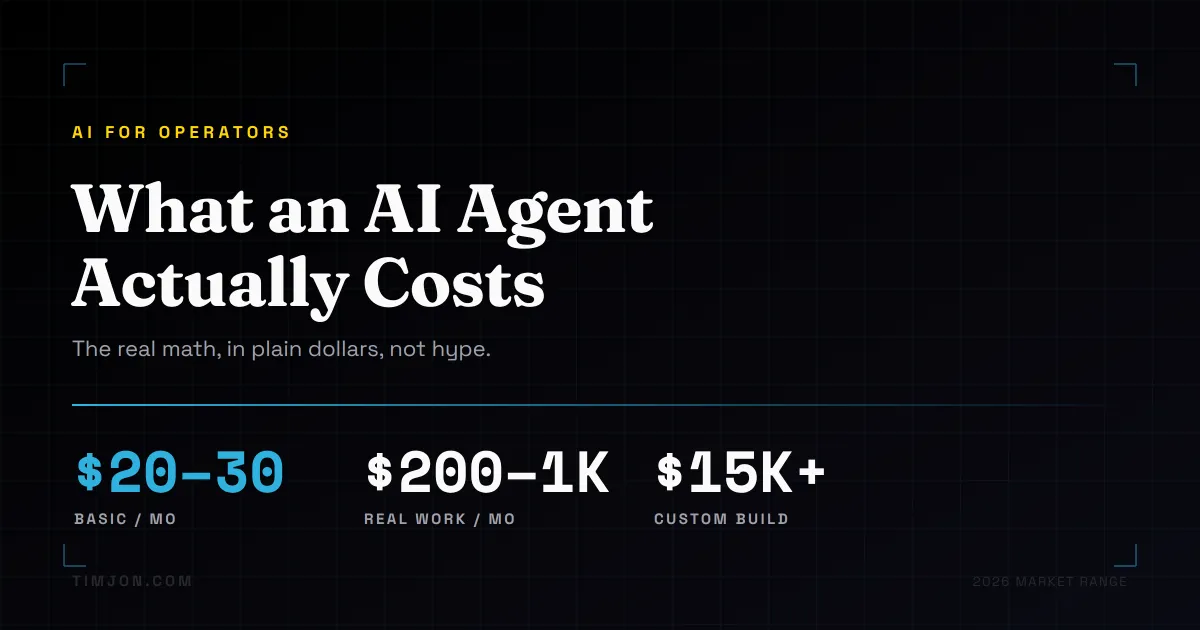
For most small operators, the tools land in a pretty ordinary range. A lot of the assistant-style subscriptions, the ones that let you build a custom helper on top of a big model, run somewhere around 20 to 30 dollars a month per person. That's the same ballpark as a couple of other software subscriptions you're probably already paying for without blinking. A basic agent that handles something narrow, like answering the same twenty questions over and over, tends to sit in the 50 to 200 dollars a month range once you're running real volume through it.
Now, if you go up a tier, to an agent that's wired into your CRM, reads your data, and actually does multi-step work, the market's landing more like a few hundred to a couple thousand a month, and most small businesses I'd point to are budgeting somewhere in the 200 to 1,000 dollars a month window to keep the lights on. And if you have somebody custom-build a whole system around your specific workflow, that's a different animal, that starts around 15,000 dollars as a one-time project before you ever pay the monthly.
These companies all price it differently, and that's the part I want you to hear. Some charge per user, some charge per conversation, some charge a flat monthly. Before you sign anything, ask the plain question: am I paying per seat, per task, or per month, and what happens to my bill when I get busy? Because a "two dollars a conversation" plan sounds like nothing until you're having a thousand conversations. My thinking is you always want to know the shape of the bill before the bill shows up, same as you'd want to know a loan's terms before you sign for the house.

The cost nobody quotes you: your time
Here's the part the pricing pages leave out, and it's the one that actually matters.
The real cost of an AI agent isn't the subscription. It's the hours it takes you to set it up right, and the attention it takes to check its work until you trust it. I run a whole team of these agents for my own business, and I'll tell you straight, the monthly software cost was never the thing I had to budget for. The thing I had to budget for was me — the evenings I spent teaching one of them what "good" looks like, the mornings I spent reading what it did overnight and correcting it.
That's not a knock on the tools. That's just the truth of handing work to anything, a person or a machine. You don't hire somebody and walk away on day one, and you don't stand up an agent and walk away either. If you want the honest picture of where that line falls, I wrote about what I actually hand off to my agents and what I still do myself, because the split matters more than the price tag.
So when you're pricing this out, don't just add up the subscriptions. Add up the setup weekend, and the fifteen minutes a day for the first month while you're checking its homework. Put a real number on your own time. If your hour is worth 50 bucks and setup eats ten hours, that's 500 dollars of you, on top of whatever the tool costs. That's not a reason to skip it. It's just a number that belongs in the math, because at the end of the day the deal only works if you counted everything.
How to tell if it's actually worth it
Alright, so you've got the monthly number and you've got the honest cost of your own time. How do you decide?
I do it the same way I'd size up anything. I ask what specific, boring, repeating job I'm trying to hand off, and whether that job is costing me 15 bucks an hour of busywork or quietly pulling me off a two-thousand-dollar deal. Not the exciting stuff, the boring stuff. The follow-up that doesn't happen because I got busy. The lead that sat in the inbox for two days. That lead wasn't a missed email, it was a job walking out the door, and that's the price the agent is really competing against even though it never shows up on an invoice.

Then I run it small. I don't hand an agent my whole business on the first day. I give it one job, the first job you should ever automate, and I watch it for a few weeks. If that one job comes back reliably and it frees up real hours, then the 30 or the 200 a month was cheap, because it bought back time I was losing anyway. If it doesn't, I've only risked one small thing, not the whole operation.
And I'd be careful about one more thing, because it trips people up. An "AI agent" and a plain old automation are not the same purchase, and folks pay agent prices for automation jobs all the time. If the work is truly just "when this happens, do that," you may not need an agent at all, you might need a much cheaper automation. I laid out the real difference between the two here, because buying the wrong one is the most common way I see people overspend.
If you're in real estate like a lot of my people are, the math gets easier to see, because the jobs are so concrete, the follow-up, the lead sorting, the first reply. I walked through what these agents actually do for an investor if you want to picture it on your own deals.
The honest bottom line
So, how much does an AI agent cost? For most small operators, the tool itself runs anywhere from about 20 dollars a month on the low end to a few hundred or a thousand once it's doing real work, with custom builds running into the thousands up front. That's the easy number.
The real cost is your time to set it up and the discipline to check it until you trust it. And the real question isn't "what does it cost," it's "what is the job it replaces costing me right now, quietly, every week." When the second number is bigger than the first, it's worth it. When it isn't, wait.
I don't want to see anybody spend money they don't have chasing a shiny tool, and I don't want to see anybody bleeding hours on work a 30-dollar helper could carry either. Count the whole thing, honest, and let the numbers tell you. Ultimately, that's the same discipline that works on any decision in this business. The tool is new. The math isn't.
Something to think about as you look at that next thing on your plate you keep meaning to hand off.
Disclaimer: This post is for informational and educational purposes only and is not financial, legal, or investment advice. Real estate carries risk, and individual results will vary depending on your market, your resources, and your effort. Do your own due diligence and consult a qualified professional before making any decisions.
