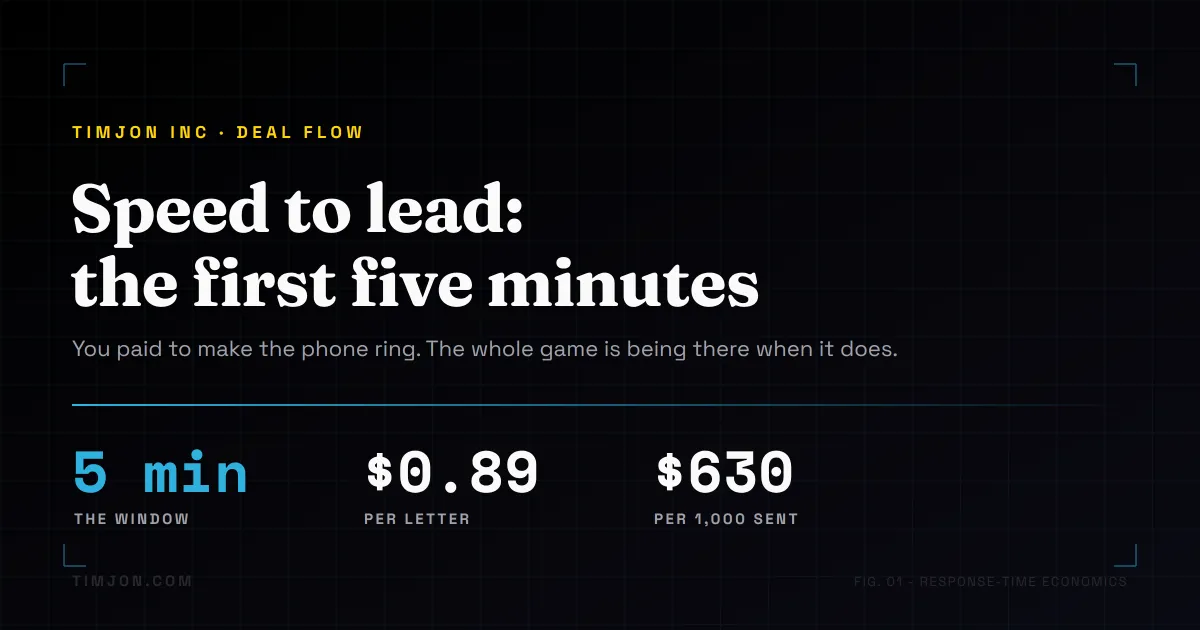

Let me start with a number, because a number is the honest way into this. A single black-and-white letter runs me about 89 cents to send one at a time. Do it at real volume, a thousand at a crack, and the per-piece cost comes down, but you're still into a big drop for around 630 bucks before you've had a single conversation. So you do the work, you spend the money, the phone finally rings on a Tuesday afternoon, and the person on the other end is a real motivated seller with a real problem. And you're up on a roof, or on another call, or you just stepped out for lunch. By the time you call back at four o'clock, they've already talked to somebody else. That 89 cents, and the hundreds of times over you spent it, just walked out the door.
That's the thing nobody warns you about when you're getting started. The hardest part isn't making the phone ring. It's being there in the first few minutes after it does. That gap has a name in the sales world, speed to lead, and at the end of the day it's one of the biggest, quietest reasons good marketing money gets wasted. So let me walk through what it actually is, why it's so brutal when you're doing this by yourself, and the plain way I handled it, including the part I refuse to automate.
What "speed to lead" actually means
Speed to lead is just how long it takes you to respond to somebody after they raise their hand. They call, they text, they fill out the form on your site, and the clock starts. What surprises most folks is how steep the drop-off is. This isn't a "sooner is a little better" situation. It's a cliff.
There's a widely cited study out of MIT, the Lead Response Management study, that looked at thousands of inbound leads. It found that reaching out within five minutes made you dramatically more likely to actually connect with a person and get them into a real conversation, compared to waiting even thirty minutes. I'm not going to throw a precise multiplier at you like it's gospel, because studies get quoted loose and I'd rather you not repeat a number you can't stand behind. But the direction is not in dispute, and it matches what I've seen with my own eyes: the difference between five minutes and an hour is the difference between a conversation and a voicemail nobody returns.
And here's the human reason underneath the data. When somebody reaches out about their house, they're usually at a specific moment. Something pushed them to pick up the phone right then, the notice showed up, the sibling called, the tenant moved out. In that window they're leaning in. An hour later the fear cools, the spouse says "let's wait," the moment closes. You're not just racing other investors. You're racing the person's own second thoughts. My thinking is that half of "the lead went cold" isn't competition at all, it's just that the door was open for a few minutes and nobody walked through it. If you want to see how the back half of this plays out, I wrote separately about following up with seller leads over the long haul, but the follow-up only matters if you caught the first moment at all.

Why doing this by yourself loses the race
Now, different folks are set up differently, and some of you reading this have a team and somebody who answers the phone. If that's you, this is a training problem, and it's solvable with a checklist and a stopwatch. But most of my people don't have that. Most of my people are the folks who have to struggle to put it together, doing this alongside a job, or as the whole operation, wearing every hat.
For one person doing this alone, five-minute response time is close to impossible by hand, and I want to be honest about that instead of pretending you just need more hustle. You can't answer a seller in five minutes when you're on a ladder. You can't answer at five minutes when you're asleep, and plenty of these calls come in at night or on a Sunday. You can't answer when you're already on the phone with a different seller, which is the cruel one, because the busier your marketing gets, the more leads you drop at the exact moment you can least afford to. Hustle doesn't fix a math problem. One person cannot be reliably reachable inside five minutes, every hour, every day. That's not a character flaw. That's just the shape of being one human being.
So for years the honest answer was "call back as fast as you reasonably can and accept you'll lose some." And you know what, that's still a fine place to start when you're brand new and every dollar counts. But at some point the leads you're dropping cost more than the fix. That's the moment to think about handing this one narrow job to a system.
How I automated the first five minutes
Here's what I actually built, and I'll show you the real shape of it, including what it doesn't do. I put a simple AI agent on the front door. When a lead comes in, by text or through the form, it responds right then, in seconds, any hour of the day. It doesn't try to be clever. It does two things: it lets the person know a real human saw them and cares, and it asks a couple of plain questions to understand the situation, the address, the timeline, what's going on. That's it. It holds the door open in the first five minutes so the moment doesn't close before I can get there.

Then, and this is the part that matters most, it hands the warm ones to me. I do not let software negotiate, and I do not let it make offers or pretend to be me. The numbers, the actual decide-with-the-seller work, the moment where somebody's telling you about their mother's house, that's mine, and it's staying mine. The agent buys me the thing I could never buy back by hustling harder: presence in the first few minutes. What I do with those minutes is still human work. I've written before about exactly where I draw that line, what I hand to AI and what I keep, because getting that boundary wrong is how you turn warm sellers cold in a different, worse way.
I'll be straight that this isn't free and it isn't magic. It took setup, it takes tending, and it will occasionally say something a little stiff that I have to go smooth over. When I first turned it on I watched every conversation like a hawk, and I'd tell you to do the same. But the trade has been worth it: money I was already spending to make the phone ring now has somebody, or something, on the other end of it at 11 p.m. on a Saturday. If you're just starting to think about where a tool like this even fits, how I use AI to find deals in the first place is the front end of the same system.
Ultimately, speed to lead isn't about being pushy or being first for its own sake. It's about being there, actually reachable, in the small window when somebody finally worked up the nerve to reach out about the hardest thing they're dealing with. You already paid the 89 cents to make that phone ring. The whole game, at the end of the day, is being on the other end when it does. That's the goal. Whether you get there with a team, a system, or just a faster thumb, close that gap, because that's where your deals are quietly living or dying.
Disclaimer: This post is for informational and educational purposes only and is not financial, legal, or investment advice. Real estate carries risk, and individual results will vary depending on your market, your resources, and your effort. Do your own due diligence and consult a qualified professional before making any decisions.
