
Let me start with a number, because a number settles arguments faster than an opinion does.
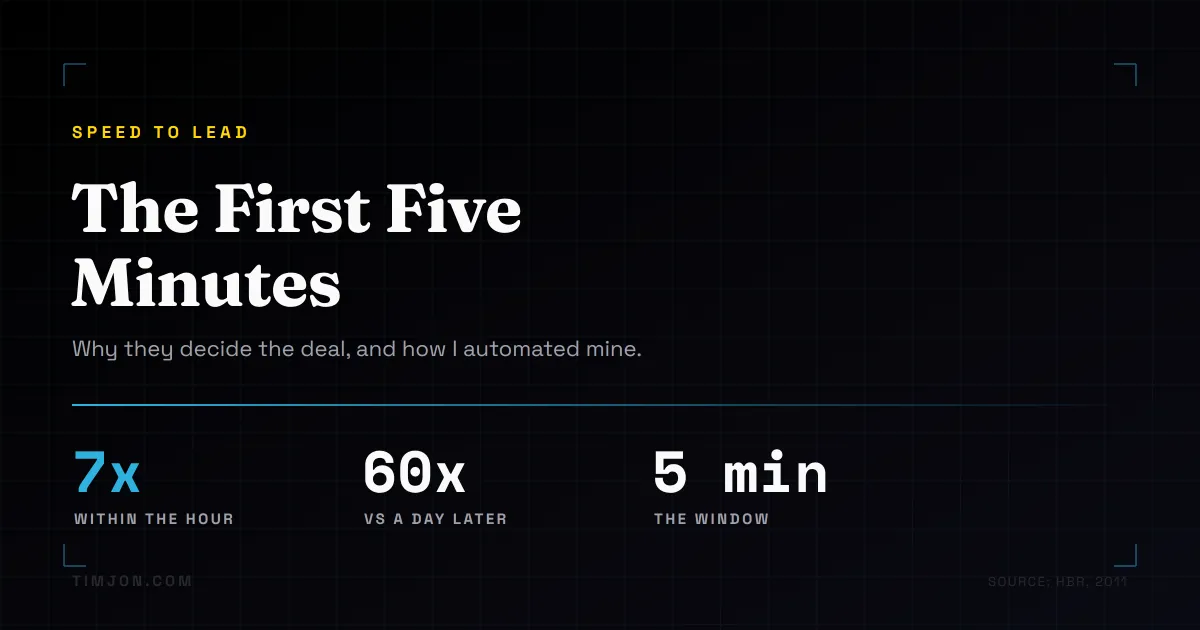
A while back some researchers went and studied thousands of real sales inquiries, and they published what they found in the Harvard Business Review under the title The Short Life of Online Sales Leads. Here's the part that stuck with me. The companies that tried to reach a new lead within the first hour were close to seven times more likely to have a real conversation with a decision maker than the ones who waited just one more hour. And more than sixty times more likely than the ones who waited a day.
Sixty times. Not sixty percent. Sixty times, just for the sin of waiting until tomorrow.
Now I want to be careful, because that study is a few years old and it was mostly business-to-business inquiries. Different world than a seller who filled out your form at eleven at night. But every time I've watched my own leads and my people's leads, the shape of the thing holds. The person who fills out a form is never more interested in you than in the sixty seconds right after they hit submit. After that, they're back to their life, they filled out three other forms, and whoever calls first is the one who becomes real to them.
That's what "speed to lead" means. It's just the gap between when somebody raises their hand and when you actually reach back. And for most of us running lean, that gap is where the money quietly leaks out.
Why the gap is so brutal for the solo operator
Here's the tension. The big operation has somebody whose only job is to pounce on a new lead. You don't. You're the one running the deal, doing the follow-up, answering the phone, and probably sitting in a truck somewhere when the lead comes in.
So the lead lands at 2:14 in the afternoon while you're walking a property. You see it at 6:30 when you finally sit down. By then four hours are gone, and those four hours cost you most of your odds before you ever said a word. It's not that you're lazy. It's that you're one person and you can't be in two places, and the lead doesn't care about your reasons.
For years my answer to this was guilt. I'd tell myself to be faster, check my phone more, feel bad when I didn't. That's not a system. That's just a promise to try harder, and a promise to try harder always loses to being one person with a full day. My thinking finally shifted to this: the first touch doesn't have to be me. It has to be good, and it has to be now. Those are two different problems, and only one of them actually requires me.
What "the first five minutes" actually needs to do
Let me be plain about what that first fast touch is even for, because folks over-build this. The first message is not the pitch. It's not the offer. It's a hand back. Its whole job is to make the person feel seen inside the window where they're still paying attention, and to hold the door open until a human can walk through it.

A good first touch does three small things. It acknowledges the specific thing they asked about, so it doesn't read like a robot. It gives them one useful next step. And it sets a real expectation for when a person will follow up. That's it. Do those three things in the first few minutes and you've bought yourself the conversation. Skip them, and you're the fourth voicemail they delete on Saturday morning.
None of that requires my hands on the keyboard at 2:14 in the afternoon. It requires the right words to go out on time. That's an automation problem, and automation problems I can solve.
How I actually handed mine to an AI agent
I run my own stack of agents. I'm not going to pretend I bought a magic button, because I didn't, and dogfooding my own tools means I get to see exactly what breaks. So here's the honest version, including the part that went wrong first.
The setup is simple in shape. A new lead hits my form or my inbox. An agent I've named and trained on how I actually talk reads what the person wrote, drafts a short first reply in my voice, and either sends it or hands it to me depending on how sure it is. Then it makes me a task to follow up as the human, with the lead's own words pulled up so I'm not starting cold. Fast first touch by the system, real relationship by me. That's the whole design.
Now the part I got wrong. My first version just sent. Every time, no gate. And it was fast, and it was polite, and it was completely tone-deaf about one out of every ten messages. Somebody would write in about a hard, personal situation, and my cheerful little agent would fire back a chipper form reply that made me wince. Fast and wrong is worse than slow and human, because slow you can apologize for. Wrong in your name, at scale, you can't take back.
So I did the boring thing that actually mattered. I added a confidence gate. When the message is ordinary, the agent sends the first touch on its own and I never think about it. When the message is heavy, or unusual, or the agent isn't sure, it drafts and waits for me. I lost a little speed on the hard ones. I kept every ounce of it on the ninety percent that are routine. And I stopped embarrassing myself.
At the end of the day, that gate is the difference between a tool that helps you and a tool that quietly costs you the relationships you were trying to protect. The system handles the clock. The human handles the heart. Blur that line and you get fast garbage.

If you're going to build one, start here
You don't need my whole stack. My thinking is you start with the smallest version that closes the worst part of the gap, then you earn the rest.
- Instrument the gap first. For one week, just write down when each lead came in and when you actually answered. You can't fix a number you've never looked at. Most folks are shocked, and a little embarrassed, by the real gap.
- Automate the acknowledgment, not the pitch. The first auto-touch should confirm you got them, give one next step, and promise a human soon. Keep the selling for the human.
- Put a gate on it. Let the automatic send handle the ordinary. Route anything heavy, weird, or uncertain to you. Fast on the easy, careful on the hard.
- Make the human step easy. Whatever tool you use should hand you the follow-up with the lead's own words already loaded, so being the human takes thirty seconds, not thirty minutes.
That last one matters more than the fancy AI part. Because being fast is worthless if the human handoff is so painful you skip it. The system exists to protect the conversation, not replace it.
If you're wondering what to hand off first before you touch lead follow-up at all, I laid out my whole order of operations in what to automate first, and I made the case for when a solo operator should even start automating. This kind of fast, human follow-up matters double in real estate, where a motivated seller is often talking to a lot of people at once. I've written before about the challenges of subject-to deals, and every one of them starts with reaching the seller before the situation moves on without you. And if you're brand new to the real estate side of this, my friend Chris up in Illinois wrote a plain-spoken guide to becoming a real estate investor that pairs well with getting your follow-up right.
Those are my people, the ones who have to struggle to put it together, one person doing the work of five. You don't beat the big operation by working more hours than they do. You beat them by refusing to let a good lead go cold while you were busy being everywhere at once. Let the system hold the door. You be the one who walks through it. That's the goal.
Disclaimer: This post is for informational and educational purposes only and is not financial, legal, or investment advice. Real estate carries risk, and individual results will vary depending on your market, your resources, and your effort. Do your own due diligence and consult a qualified professional before making any decisions.
