
Somebody asked me this here in the DFW area last week, and I could tell he was excited. He'd set up an AI voice agent to call his seller leads, and it was working. It was dialing, talking, sounding like a person. So his next thought was the natural one: if it can talk, can I just let it handle the whole conversation, objections and all, and close the thing while I'm asleep?
My thinking is, slow down for a second. Not because the technology can't do impressive things. It can. But there's a line I draw when I build these systems, and it's the same line whether I'm handing work to a person on my team or to a piece of software. Some parts of a deal you can delegate all day long. And some parts are the deal.
Let me walk through how I think about it, because I build this stuff for a living and I still keep a human on one specific job.
First, what counts as an objection, and what doesn't
Here's a distinction worth getting straight, because people blur it and then argue about the wrong thing.
Booking an appointment is a logistics problem. Somebody's willing to talk, and you're finding a time that works. "Does Tuesday at six work, or is morning better?" That's not an objection. That's scheduling. An agent is wonderful at scheduling. It never forgets, never gets distracted, and it'll offer three time slots without an ounce of ego.
An objection is a different animal. An objection is when the seller pushes back on the substance. "That price is too low." "I'm not sure I trust this." "My brother says I should list it." "I need to think about it." Those aren't scheduling problems. Those are human moments, and underneath almost every one of them is something real. Fear. Grief. A situation they haven't told you the whole truth about yet. When somebody says "I need to think about it," they rarely mean they need to think. They mean something hasn't been answered, and you haven't earned it yet.
So the real question isn't "can the AI talk." It's "who do I want in the room when a scared or grieving person pushes back on the biggest financial decision of their year." When you frame it that way, the answer gets clearer. If you want the fuller version of where I personally draw these lines, I laid it out in what I hand off to AI agents and what I still do myself. This post is me zooming in on the hardest part of that line.
What AI is genuinely good at: the reach and the booking
I don't want to undersell the tool, because the reach is where most folks are actually losing deals, and this is exactly where AI earns its keep.
Think about the math of follow-up. You get a lead. You call once, they don't pick up, and life happens. You mean to call back and you don't. That lead goes cold, not because it was bad, but because you're one person with a limited number of hours. I've watched good operators leave real money sitting in a list they simply never worked. A tireless agent that reaches out fast, then follows up on day two, day five, day twelve, without getting bored or discouraged, will beat a talented human who only gets to it when he remembers. Speed and consistency win here, and a good system has both in a way a person never will. That's the whole reason I lean on AI for the follow-up you keep dropping.

It's also good at the sorting. A lot of the people on any list aren't going anywhere. They're curious, they filled out a form, they're not motivated. Letting an agent do the first pass, figure out who's actually got a situation, and get the willing ones onto my calendar, that's a real gift. It hands me the ten conversations worth having instead of the hundred that weren't. If you're fuzzy on what these agents actually do in a day, I walked through it in what AI agents actually do for real estate investors, and on the difference between an agent and plain old automation in AI agents vs. automation.
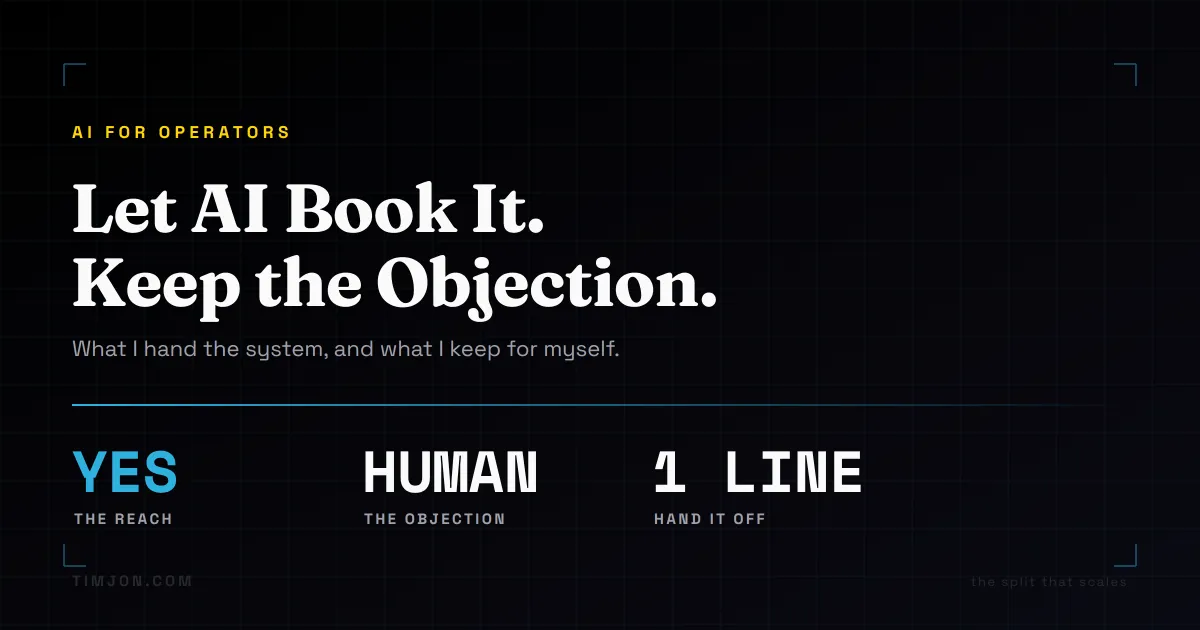
So my answer on the reach is a full yes. Let the agent dial, let it follow up, let it qualify, let it book. That's not the part I'm protective of. Follow-up is a numbers game, and the numbers are exactly where a tireless system shines; I dug into how many touches it really takes in how many times you should follow up with a motivated seller. A tireless system will out-follow-up any human alive.
Why I keep a human on the objection
Now here's where I put my foot down, at least for how I build things today.
When a real objection lands, I want a human on it. Not because a bot can't string together a smooth-sounding response. It can, and that's actually part of the danger. Handling an objection well isn't about having the slickest line. It's about hearing the thing under the thing. It's catching that the seller's voice cracked when they mentioned their late husband's house. It's knowing when to stop talking. It's deciding, in the moment, to set the deal aside because this person needs a human being more than they need a buyer right now. A mentor of mine up in Illinois, Chris Albin, says we decide with the owner against their challenge, not against the owner. You can't automate that posture. It's a choice a person makes.

And the stakes aren't symmetric, which is the part people miss. If the AI fumbles a scheduling question, no harm done, you recover on the next touch. But if it mishandles a grieving seller's objection, argues with them, sounds a hair too smooth at exactly the wrong moment, you don't usually get that trust back. A booked call you can rebook. A burned trust you often can't. When the downside is that lopsided, I don't hand the job to a system that doesn't feel the weight of it.
So what do I actually let the agent do when it bumps into an objection? Its job in that moment is simple: don't try to win it. Acknowledge the person, don't argue, and hand it to me warm. Something like, "That's a fair thing to raise, and it deserves a real conversation. Let me get you time with Tim." The agent's one job on an objection is to not make it worse and to get me into the room. That's it. Then I take the substance, and I bring the seller real options instead of a single take-it-or-leave-it number, the way I teach with the four offers method. Four honest ways to solve their situation is a human conversation. It always will be.
I'll be honest that this line will move. The tools are getting better fast, and I'd be a poor teacher if I told you it'll always sit exactly here. There may come a day the tools handle more of the soft stuff well enough. But the way I decide isn't "what can the AI technically do." It's "what am I comfortable being wrong about." I'm comfortable being wrong about a scheduling slot. I am not comfortable being wrong about the moment a scared person decides whether to trust me. Until that changes, the objection stays with a human.
At the end of the day, delegate the reach, keep the relationship
If you take one thing from this, let it be the shape of the line, not the exact spot. Hand the system the work that's about volume, speed, and consistency: the dialing, the following up, the qualifying, the booking. Those are the parts you're probably losing deals on anyway. Keep for yourself the work that's about a human being making a hard decision under pressure, because that's not a task, that's the relationship, and the relationship is the business.
Ultimately, an AI agent is the best assistant you'll ever have and a poor substitute for you in the one moment that matters most. Point it at the reach. Show up for the objection. Those are my people, the folks who have to struggle to put it all together, and this is the split that lets you scale without handing away the part a seller will actually remember.
Disclaimer: This post is for informational and educational purposes only and is not financial, legal, or investment advice. Real estate carries risk, and individual results will vary depending on your market, your resources, and your effort. Do your own due diligence and consult a qualified professional before making any decisions.
