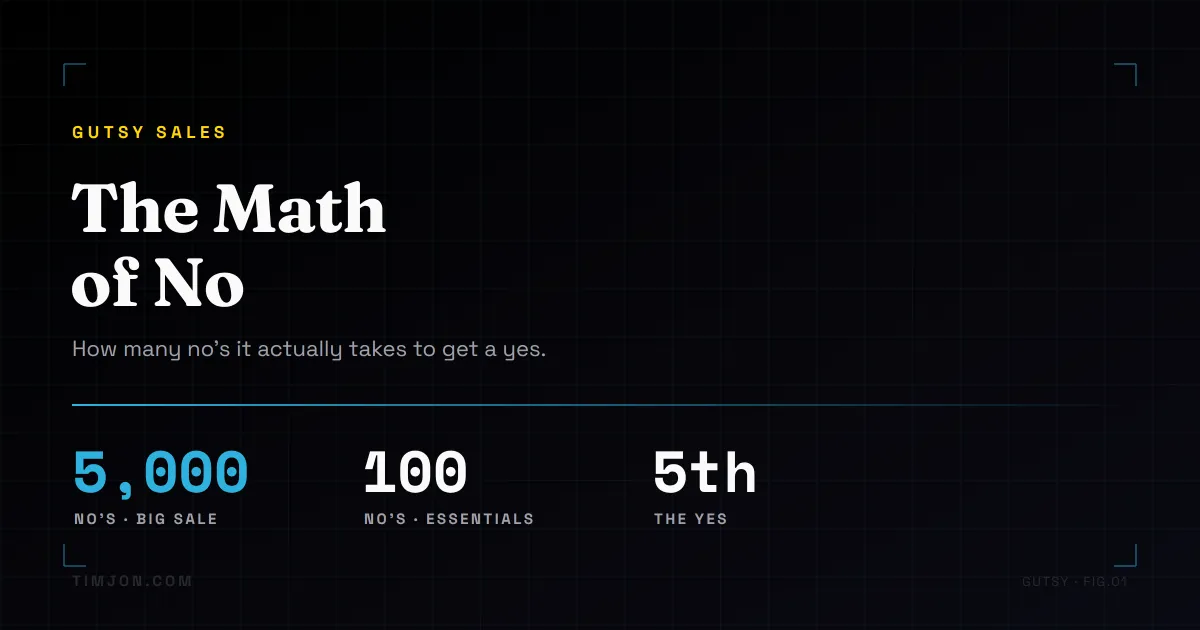

Here's a number I say out loud to my people all the time, and it makes some of them flinch: five thousand. That's roughly how many no's you might have to move through to sell a 25,000-dollar package. Now here's the other side of the same number, and this is the part that changes everything. To sell the smaller thing, the essentials, the first honest step, you might only have to move through a hundred no's, and you can revenue it right away.
Same person, same effort, wildly different math depending on what you're selling and how you count. My thinking is that most folks never sell anything, not because they can't, but because nobody ever handed them the math. They heard "no" once, maybe twice, and they decided the whole thing was broken. It isn't broken. You just hit the front of a number you didn't know you were standing in. Let me walk you through how I actually count the no's, because at the end of the day, once you see the math, rejection stops being a wound and starts being inventory.
The no's aren't random, they're a ratio
The first thing to understand is that a "no" is not a verdict on you. It's a data point in a ratio. If it takes a hundred conversations to make one sale, then every single conversation, yes or no, is worth one one-hundredth of that sale. The no's aren't the opposite of the yes. They're the price of it. You're not failing your way to a yes, you're paying your way to one, in a currency called conversations.
There's real research behind this, and it lines up with what I've watched in the field. Studies of cold outreach have found that a lot of prospects say no four times before they ever say yes on the fifth touch, and yet only a small slice of salespeople, low single digits in some of that data, ever make it to that fifth follow-up. Sit with that for a second. The yes is often sitting right behind the fourth no, and almost everybody quits at one or two. I don't share that number to make you feel guilty. I share it because it means the game isn't nearly as crowded as it looks. Most people beat themselves before the math ever gets a chance to work.
Now, I want to be careful here, because I don't want you to hear "just bug people until they cave." That's not it at all. The follow-up only works when there's real value on the other end and you actually believe the person is better off saying yes. A no from someone who genuinely isn't a fit is a gift, it frees up your hundred conversations for the people who are. The discipline isn't stubbornness. It's respect for the numbers, the same respect I bring to analyzing a real estate deal before I ever make an offer. You know your numbers, so you don't panic at any single one of them.

Why one no feels like a hundred
If the math is this simple, why does it hurt so much? Because a no doesn't arrive as a number. It arrives as a feeling, and the feeling is a lot louder than the ratio. Somebody says "no thanks" and your body treats it like a threat, your focus narrows down to that one rejection, and the story you tell yourself gets ugly fast. "I'm not good at this. This doesn't work. Who am I to be doing this."
I've come to believe that feeling isn't the truth, it's just a thought passing through, and you don't have to build a house on it. I wrote about that more fully in a piece on the three principles of human experience, but the short version is this: the no didn't do anything to you. Your thinking about the no did. And thinking moves. The rejection that feels like the end of the world at nine in the morning is a shrug by lunch, same facts, different weather inside your head. Once you really get that, you stop needing every conversation to go well in order to keep going. You can let a no be a no and reach for the next number.
That reframe is where a mentor of mine, Claude Diamond, was a huge influence on me. He drills a daily discipline into people, a set number of real activities you do every single day no matter how you feel about yesterday, and I won't reproduce his material here because it's his to teach. But the principle underneath it changed how I work: you don't chase a feeling, you keep a cadence. The person who makes their calls on the day they got told no four times is the person who's still standing when the fifth conversation turns into a yes. Ultimately, consistency beats intensity, because consistency is what lets the ratio express itself.

Count the no's on purpose
So here's the practical piece, the part you can actually do tomorrow. Start counting your no's on purpose, and treat them like progress instead of like proof you're failing. If you know your rough ratio, and early on you won't, so you'll just have to gather it, then every no is you working through your inventory toward the yes you already know is in there. Ten no's isn't ten failures. It's ten out of a hundred. You're a tenth of the way to a sale you can basically count on if you keep going.
This is also why the size of the ask matters so much, and it's worth thinking about before you burn yourself out. Five thousand no's for a big-ticket sale is a real number, but a hundred no's for a smaller, honest first offer is a completely different mountain, and you can revenue that one immediately. My thinking is that a lot of new folks aim at the five-thousand-no product on day one, get flattened, and quit, when they should have started with the hundred-no offer, built some wins and some cash flow, and grown into the bigger number. Start where the math is kind to you. It's the same reason I tell real estate folks to learn the creative, low-cost strategies first, before they go swinging for the deals that take a war chest and a thick skin. Get a rep. Get a yes. Let the wins fund the next stretch of no's.
At the end of the day, this is the thing I most want my people to hear, and my people are the folks who have to struggle to put it together, who don't have a warm network or a famous name to open doors. The no's are not the problem. The no's are the path. Every one of them is a step you've already taken, a number you've already spent, moving you closer to a yes that was always going to cost exactly what it costs. Nobody gets the yes without walking through the no's. The only question is whether you'll still be counting when you get to the one that pays. I don't know if that answers every worry you've got about picking up the phone, but it's the math I'd want somebody to have handed me a lot sooner. Something to think about as you go forward.
Disclaimer: This post is for informational and educational purposes only and is not financial, legal, or investment advice. Real estate carries risk, and individual results will vary depending on your market, your resources, and your effort. Do your own due diligence and consult a qualified professional before making any decisions.
