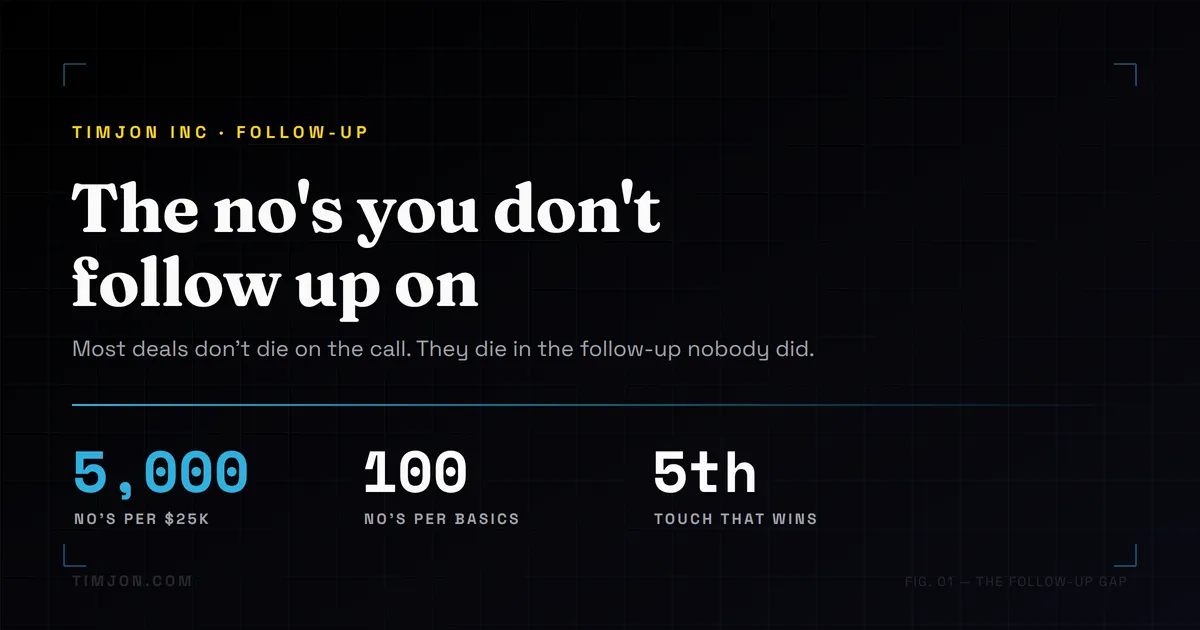

So here's a number I keep coming back to. You might have to go through 5,000 no's to sell a 25,000 dollar package, where you might only have to go through 100 no's to sell the essentials. I got that framing from Claude Diamond years ago, and it stuck with me because it's honest. The no's are not the enemy. The no's are the price. The question that actually decides whether you make a living in this is a smaller, quieter one: how many of those no's do you actually follow up on?
Because here's what I've watched happen to good people, over and over. They don't lose the deal on the call. They lose it three weeks later, in the follow-up that nobody did. The lead went cold not because it was a bad lead, but because it sat in a notebook while they were busy being the whole business at once.
That's the thing I want to talk about. Not motivation. Not "just follow up more." A system that does the following up for you, so the no's get worked whether you remembered them or not.
Where the deals actually die
Let me put it in plain numbers, because vague motivation is worthless here. Say you talk to a new lead and they say "not right now." Most folks make one, maybe two attempts, and then they quietly give up. The data on this is brutal and it's been brutal for decades: a huge share of sales happen after the fifth contact, and most people stop at the second. So the person who follows up a sixth time isn't smarter or slicker. They just showed up when everyone else went home.
Now do the math on being a one-person shop. If you're generating leads, taking the calls, writing the offers, and doing the actual work, when exactly is the fifth follow-up supposed to happen? It isn't. Not because you're lazy — because you're one person and there are only so many hours. "No for now" turns into "no forever" not by decision but by neglect.
That's the real problem, and it's a systems problem, not a discipline problem. My thinking is you don't fix a systems problem by trying harder. You fix it by building something that does the remembering for you. If you're still deciding whether you're even at the point where automating makes sense, I walked through that honestly in when a solo investor should start automating — this post assumes you've hit that wall.

What a follow-up system actually does
Here's the concrete version, because I don't want to hand you a buzzword. A follow-up system is just three plain pieces working together.
First, a place to hold every lead — a simple CRM. Every person who ever said "not right now" gets a record, a tag for where they are, and a next date. Nothing fancy. The whole job of this layer is that no lead ever falls out of the world just because you got busy.
Second, a sequence that fires on its own. When someone says "no for now," they get dropped into a follow-up track — a text a few days out, an email the next week, a check-in the week after. Written in your voice, spaced like a real person would space them, not a firehose. Three touches over three weeks, not thirty over three days. This runs while you sleep. You wake up and three of yesterday's "maybes" got a warm, human-sounding touch without you lifting a finger, and you didn't have to remember a single one of them. That's the whole point — the remembering is the part that breaks first when you're busy, so the remembering is the first thing you hand off.
Third — and this is the part that's actually new — an AI layer that drafts the reply when a lead writes back. This is where a lot of people either overhype it or dismiss it, so let me be straight about the line. Automation sends the message on a timer. An AI agent reads what the person actually said and drafts a response to that. Those are different jobs, and confusing them is where people waste money — I broke the difference all the way down in AI agents vs automation: the real difference. For follow-up, you want both: the timer keeps the cadence, the agent handles the reply so a live "yeah actually, can we talk?" never sits unanswered for six hours.
I'll tell you what didn't work, too, because I dogfood this stuff on my own team and I'd rather show you the scar. The first version I built let the AI send replies on its own with nobody checking. It was fast and it was wrong just often enough to cost me. So now the agent drafts, and a person approves before anything goes out to a live lead. Slower by about ten seconds. Worth it every time. My thinking is the point of the setup is to remove the busywork, not the judgment.

What to automate first
Don't try to build the whole thing in a weekend. That's how people end up with a half-wired system they don't trust and quietly abandon. Walk it in order.
Start with the CRM and one tag. Just get every lead in one place and mark who said "not right now." That alone, with no automation at all, will make you money, because now you can see the pile you've been forgetting.
Then add one sequence. Pick your most common "no for now" and write three messages in your own words. Space them out over two or three weeks. Turn it on for new leads only, so you're not blasting your whole old list on day one. Watch it for a couple weeks. Fix the words that feel off.
Only then reach for the AI layer, and only for the piece that's actually eating your time — usually the first draft of the reply. I built the seller-lead version of exactly this, and I walked through how the pieces fit in AI follow-up for real estate seller leads; the shape is the same whether you're chasing houses or clients.
Notice the pattern. Each step earns the next one. You're not betting on a big system working someday — you're stacking small pieces that each pay for themselves. Ultimately that's the only kind of automation I trust: the kind you'd keep even if the next piece never got built.
At the end of the day
The follow-up system isn't about doing more. It's about the no's you already earned not going to waste while you're asleep or heads-down on the actual work. You did the hard part — you got in front of people. A system just makes sure the twelfth of them who was always going to say yes actually gets the sixth message that gets them there.
Those are my people, the ones this is for — the folks who have to struggle to put it together, who are doing the calls and the work and the invoicing all at once and losing good leads in the cracks. You don't need to run yourself ragged doing it all by hand. You need to build one small, honest system that catches what you'd otherwise drop. Start with the one tag. That's the goal. Everything else stacks on top of it.
Disclaimer: This post is for informational and educational purposes only and is not financial, legal, or investment advice. Real estate carries risk, and individual results will vary depending on your market, your resources, and your effort. Do your own due diligence and consult a qualified professional before making any decisions.
