
Somebody asks me this almost every week now: "Tim, can I just have an AI make my cold calls?" And I get why. Nobody wants to sit there and dial two hundred numbers to get one person who'll actually talk. So the honest answer is yes, an AI agent can make the calls. But that's not really the question. The question is which part of the call it can make, and which part is still yours. Different tools do it differently, and some do it better than others, so let's walk through what's actually going on before you hand over the phone.
What the AI is actually doing on the call
When people picture an AI making calls, they picture a robot voice reading a script. It's past that now. The tools out there today (you'll hear names like Bland, Retell, and Synthflow) all do the same basic thing: you upload a list, the agent dials, and it holds a real back-and-forth conversation. It asks if you're the owner. It asks if you'd ever consider selling. It listens to the answer, and it follows up based on what the person actually said, not just the next line in a script.
Then it does the one thing that matters most for a busy operator: it sorts. Most of the people you call are a no, and that's fine, the AI hears the no, marks it, and moves on without getting its feelings hurt. The handful who say "well, maybe, what are you offering?" get flagged and handed to you, or booked straight onto your calendar. So the machine isn't replacing the salesperson. It's doing the front part, the dialing and the sorting, so a live human only spends time on the conversations that are actually alive. If you want the fuller picture of where this fits, I laid out what AI agents actually do for a real estate investor in a separate piece, because cold calling is just one job you can hand off.
The math is the whole reason this works
Here's why I even bother with this, and it comes down to numbers, the way most things do.
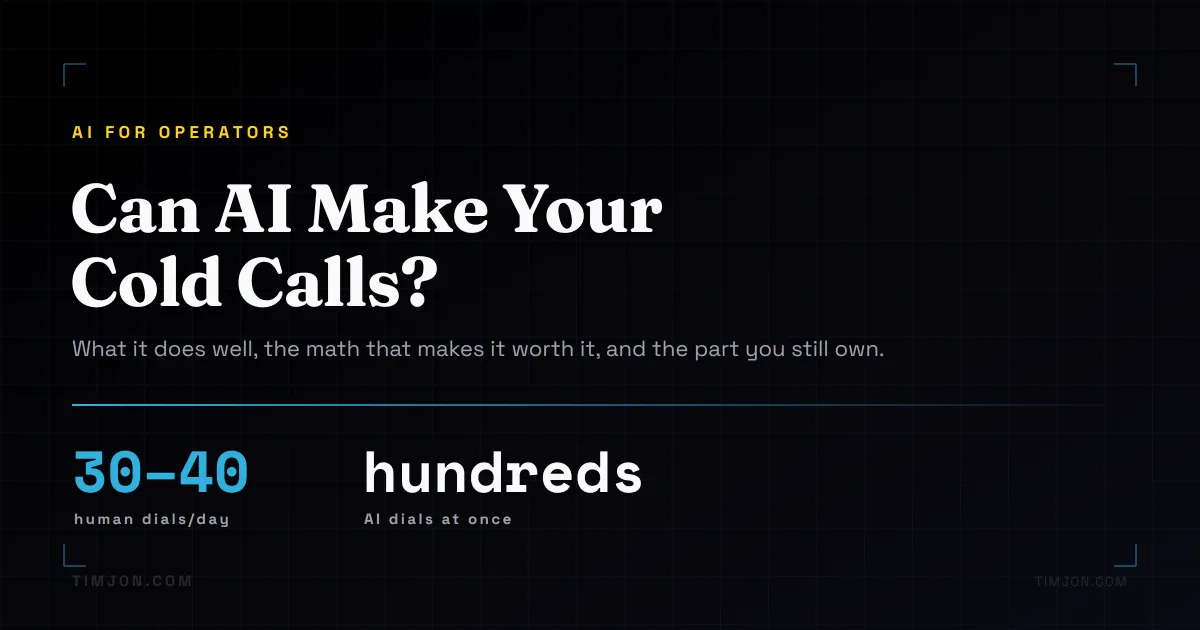
A good human caller, somebody focused, no distractions, makes maybe 30 to 40 real dials in a day before their voice and their spirit give out. That was always the ceiling. It's not that people are lazy; it's that dialing is a grind and there are only so many hours. An AI agent doesn't have that ceiling. It can work a list of hundreds at the same time, and it never gets tired at call number 38.

And the volume isn't just about ego. There's a pattern that shows up over and over in this business: the leads that convert are usually the ones you touched more than once. Industry folks will tell you that leads who get six or more contact attempts convert at a much higher rate, some put it around 70% higher, than the ones you called once and gave up on. That's the whole game. A human who's exhausted after 40 dials almost never circles back for touch number six. The machine does it every time, without being reminded. That follow-up discipline is so important that I gave it its own write-up on automating seller follow-up, because the money is usually in the fifth and sixth touch, not the first.
Now put a dollar on it. The traditional way to get this volume was to hire an inside salesperson to dial for you, an ISA, and a real one runs you somewhere around $40,000 to $60,000 a year, plus the managing, the training, the sick days, the turnover. An AI agent doing the front-end dialing costs a small fraction of that, and it's the same every single day. When the math is "one caller who does 40 and quits" against "a system that does hundreds and never quits, for a fraction of a salary," you can see why my people, the folks who have to build this thing themselves without a big team, get excited about it. If you're trying to figure out whether you're even at the point where this makes sense, I wrote about when a solo investor should actually start automating so you don't automate the wrong thing first.
What it still can't do, and why that part is yours
Now here's where I have to be straight with you, because the hype online skips this part.
The AI is good at the front of the call. It is not the person who closes the deal. The moment a seller stops giving information and starts telling you the real thing: "my brother and I inherited this and we don't agree," "I owe more than it's worth," "I'm scared to sign anything" — that's not a scripting problem anymore. That's a human being with a challenge, and solving it takes judgment, patience, and the ability to sit in a hard moment with somebody. A machine can route that conversation to you. It can't be you in it.

That's actually the right division of labor, and it's how I'd set it up. Let the agent do the volume, the dialing, the qualifying, the "are you even open to it." Then you, the human, walk in for the part that needs a human: understanding what the seller actually needs, and building them a real offer instead of a lowball. My whole approach to that back half is giving a seller four real offers instead of one take-it-or-leave-it number, and no AI on the market is doing that for you; it takes a person who cares how the seller comes out the other side. Chris Albin, who I do a lot of this work alongside, has a good piece on talking to motivated sellers without feeling pushy that's worth reading right after this one, because the softer that human conversation is, the more the whole system is worth.
So can an AI agent make your cold calls? Yes, and my thinking is you should let it, once you've got the rest of your process figured out. But go in clear-eyed about what you're buying. You're not buying a salesperson. You're buying back the top of your funnel: the dialing, the sorting, the tireless follow-up that used to cost you a $50,000 hire or your own evenings. What you keep is the part that was always the real work anyway: the conversation where somebody's biggest asset and their trust are on the table.
At the end of the day, that's the pattern with all of this AI stuff. It doesn't replace the operator. It takes the grind off your plate so you can spend your hours where you're actually irreplaceable. Start it on the boring, high-volume layer, keep your hands on the human layer, and you'll get the best of both. Ultimately, that's the goal. I don't know if that answers the question, but it's where I'd start if it were my list and my phone. And if finding the list is your bottleneck before the calling even begins, here's how I use AI to find real estate deals in the first place.
Disclaimer: This post is for informational and educational purposes only and is not financial, legal, or investment advice. Real estate carries risk, and individual results will vary depending on your market, your resources, and your effort. Do your own due diligence and consult a qualified professional before making any decisions.
